

Processing New Processes

trigger warnings: blood, butchering animals
Have you ever spilled the blood of an animal you would later be satiated by?
We are too far removed from our food. Most people may never practice animal husbandry and butcher their own meat, but that doesn’t mean they can’t fully appreciate and respect the process that it takes to put food on our plates. I don’t know about you, but I eat chicken almost every single day. We deserve access to humanely and locally raised meat, access to produce so fresh it was picked that morning, or within the week - and grown in soil only miles from where you live, not hundreds or even thousands of miles away. We have to make an effort to support and save the farms who are trying to make food that is good for you again. Food that isn’t harming the environment, food that hasn’t been depleted to a fraction of the nutrients it should provide you.
I don’t know how to make people care about the environment when it feels like common sense to me. I can spit out fear mongering facts about the rapid rate with which the glaciers are melting, the number of pollinators disappearing year after year, the species we have lost entirely; but that has never seemed to work, never felt right. Maybe I can make you care by sharing the beauty of it instead, by tugging at your heart strings, by making you fall in love with the natural world. After all, everything we have and know comes from the Earth. The simple magic of watching a seedling burst forth from flats of soil is more mesmerizing to me than the mass manipulation of resources that gives us the technologies we now know, such as the device you are reading this from.
I must admit to feeling under-qualified to write about this topic, about animal husbandry, however I hope sharing my experience can bring at least one reader closer to the food they consume, especially those of you also from the United States. I have watched the size of chicken breast in my life time steadily increase, to the point where my husband asks me not to purchase chicken from certain stores anymore, concerned about what we are consuming. Imagine how large and miserable this one was…could she even support herself on her little chicken legs? (The answer is no…there is evidence everywhere of meat birds raised on a large scale becoming so big that they break their legs, their final days spent squatting, stuck.) I am not here to argue about how to humanely raise animals for meat, and I recognize that so many people can be fed with modern technology in farming. I only to hope to help you understand that the mega-industrialization of food has its downsides and to implore you to find ways to source your meat and produce locally, to shift your mindset around your food and consumption.
I picked up a book from the library recently that brought me back to last summer when I helped a local farm during one of their chicken processing days. Pig Years by Ellyn Gaydos captured me from the very first line of the author’s note: “This story started as notes I was taking on pigs, but if I was going to write about pigs I’d have to write about the moon too and the wild creatures at the perimeters of the pig pens and eventually my eye would follow the bees into the flowers; all of it connected” I just adore when nonfiction reads that poetically, and I love learning about people’s experiences working on or owning a farm. This book dives into her years as a farmhand, in New York for some seasons and Virginia for others, raising pigs, processing meat, planting and harvesting produce, living on the properties, sometimes being the only help besides the farmers themselves. I sometimes feel I have been cheated, not knowing that this was a lifestyle option when I was growing up. As I read, I feel I am right there beside Ellyn in the sweltering summer heat, covered in small itchy scrapes from picking zucchini and tomatoes. Her writing is visceral, descriptive, and honest.
“I keep seeing death’s face in different ways. It is funny to choose a profession, like farming, in which death is taken into the fold and yet nothing is clarified. It does not steady me for loss even if I have held a pig’s head in my hand or seen a chicken collapse in the dirt. It is like a blunting of the real. Life is cauterized and then the camera pans left onto that which still breathes, photosynthesizes, or sounds.”
Finally, let me explain the process of slaughtering a chicken.
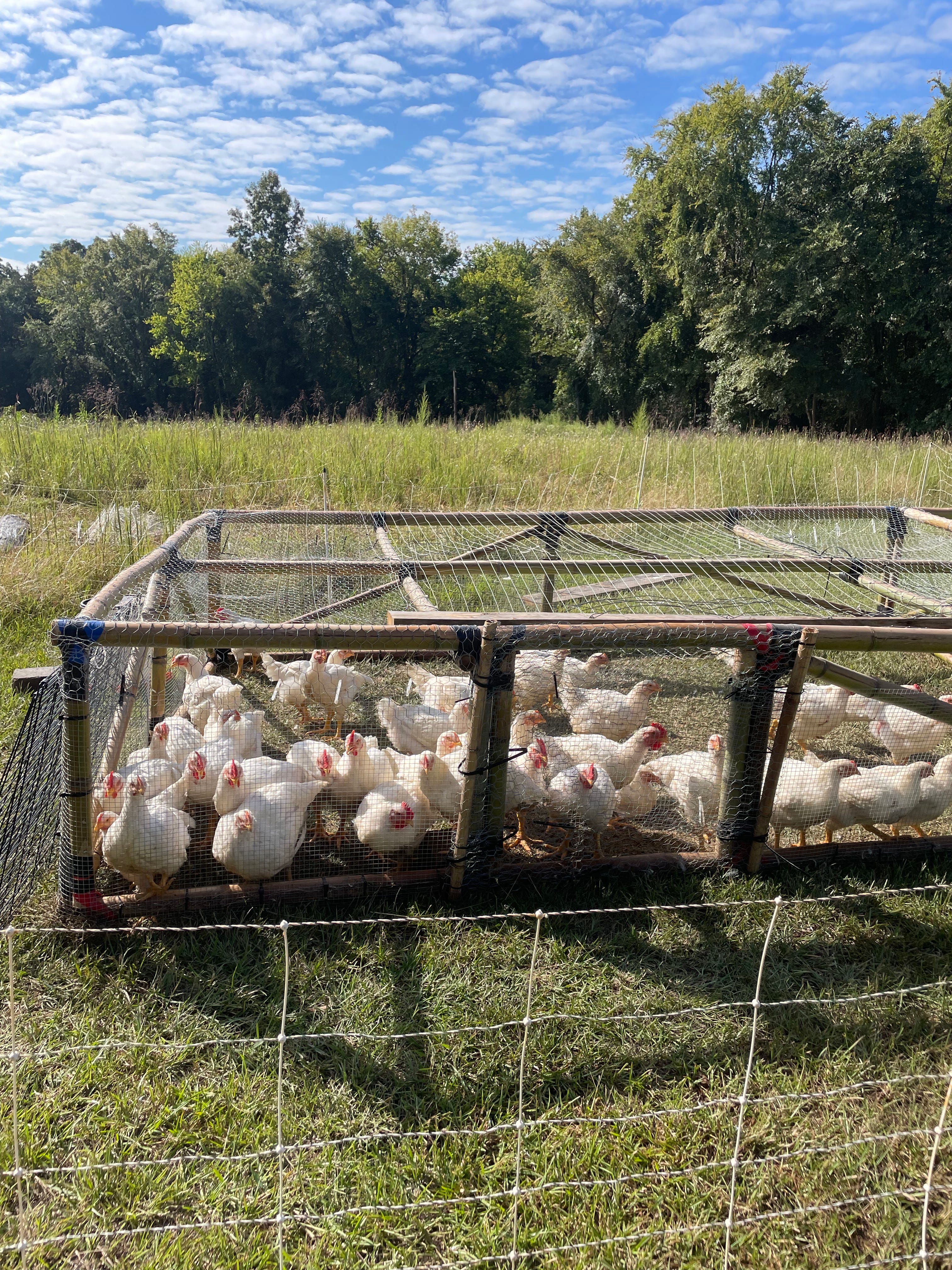
I arrived at 9:30 AM with my two-year old daughter in tow, the couple who owned the farm had a young son and said there would be other volunteers with children there as well. It was already warm, the air thick with moisture. At the Farm (in order to remain discrete about my exact location I am going to keep the actual name of the farm private, I hope you understand), they raise meat birds in chicken tractors, small wooden structures wrapped in chicken wire that have wheels at the base of one end a large handle for moving the unit on the other. Each one holds 20-40 birds, give or take. There is a water mechanism inside for the birds to have consistent access to clean drinking water, and the tractor is moved daily to provide a fresh lay of grass. Yoinking a chicken is actually simpler than I thought, albeit intimidating at first - you simply lift the lid, reach in, and grab one by the legs. They sometimes flap their wings, confused and slightly frightened, but soon the blood begins to rush to their head and it makes the bird immediately calm, seemingly in a dream-like trance. So there I was, a backyard gardener carrying chickens upside down by their legs from the tractors to the cones, sometime even two at a time as I got more confident with each grab. From the tractor you walk 50 yards to the edge of the tree-line where there are metal cones bolted to a couple of trees, where the chickens will be slaughtered.
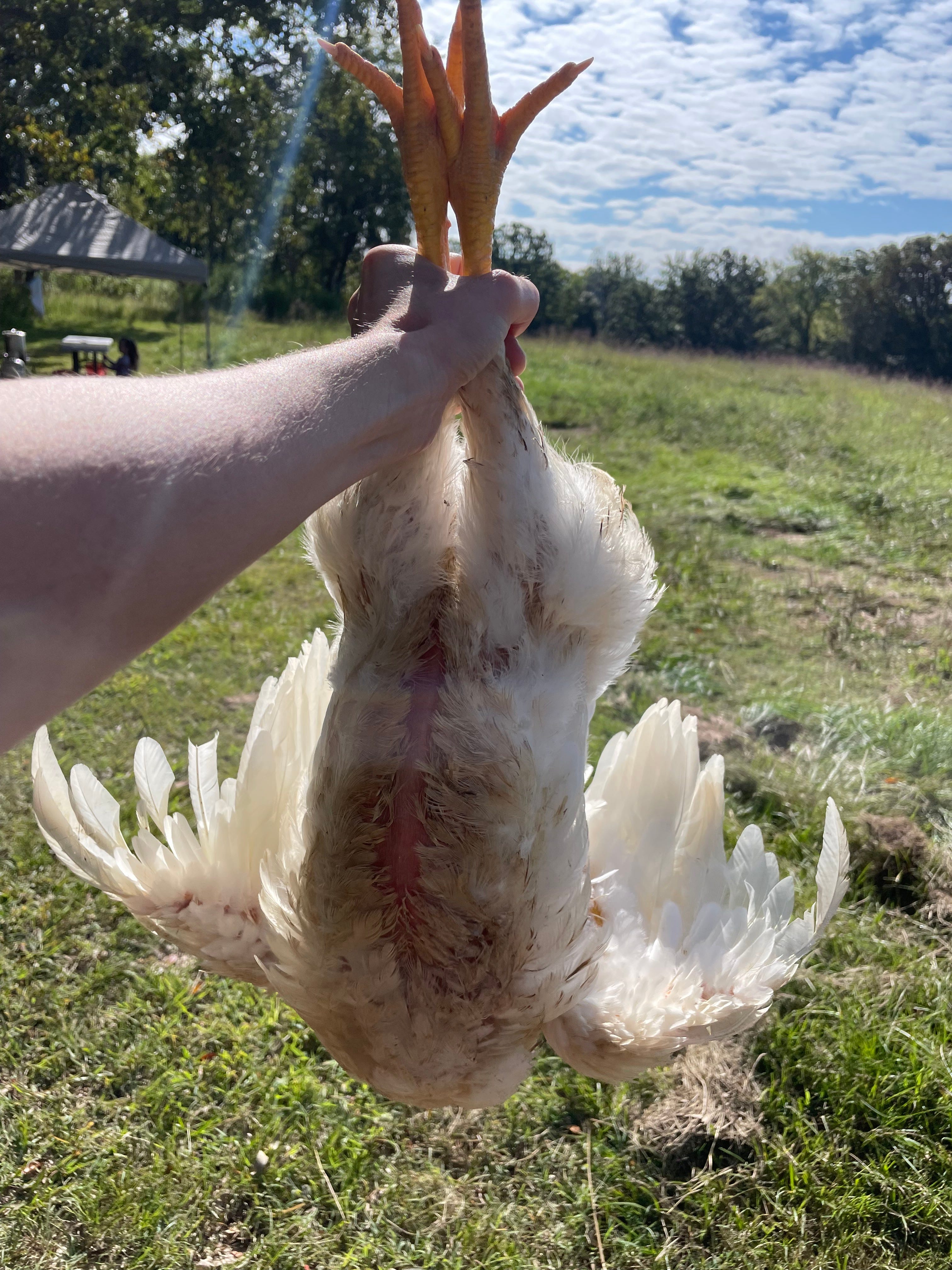
The cones are arguably the most important step, as there is a reason behind the saying “running around like a chicken with its head cut off…” A chicken can literally run around without a head, full rigor mortis taking time to settle the restless bird body, hormones pulsing frantically even in death. The “effective neck cutting of poultry” guide from the Humane Slaughter Association says to let the bird bleed for 2.5 - 3 minutes before removing the bird from the cone, however Hannah, the head of the Farm, asked us to wait 5 - 10 minutes as she had seen a headless bird run off after 15 minutes in the cone one time (but she thinks the neck was improperly cut, its easy to go too shallow.) A girl named Rosalie confidently showed us how to properly slaughter the birds, how to feel for the space that gives way to your fingers just below the jaw bone, emphasizing to penetrate deeply enough with your blade that you actually cut the carotid artery.
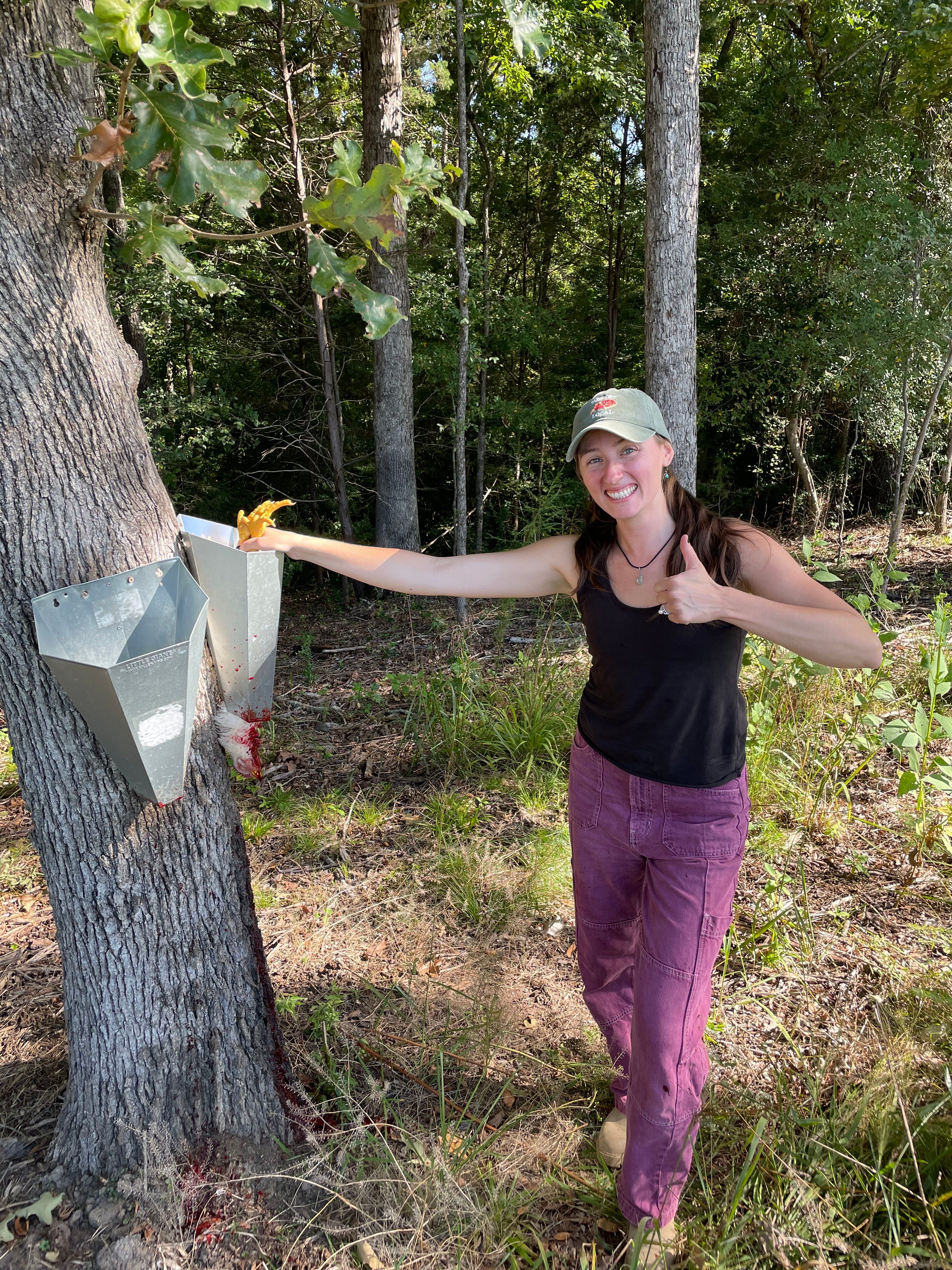
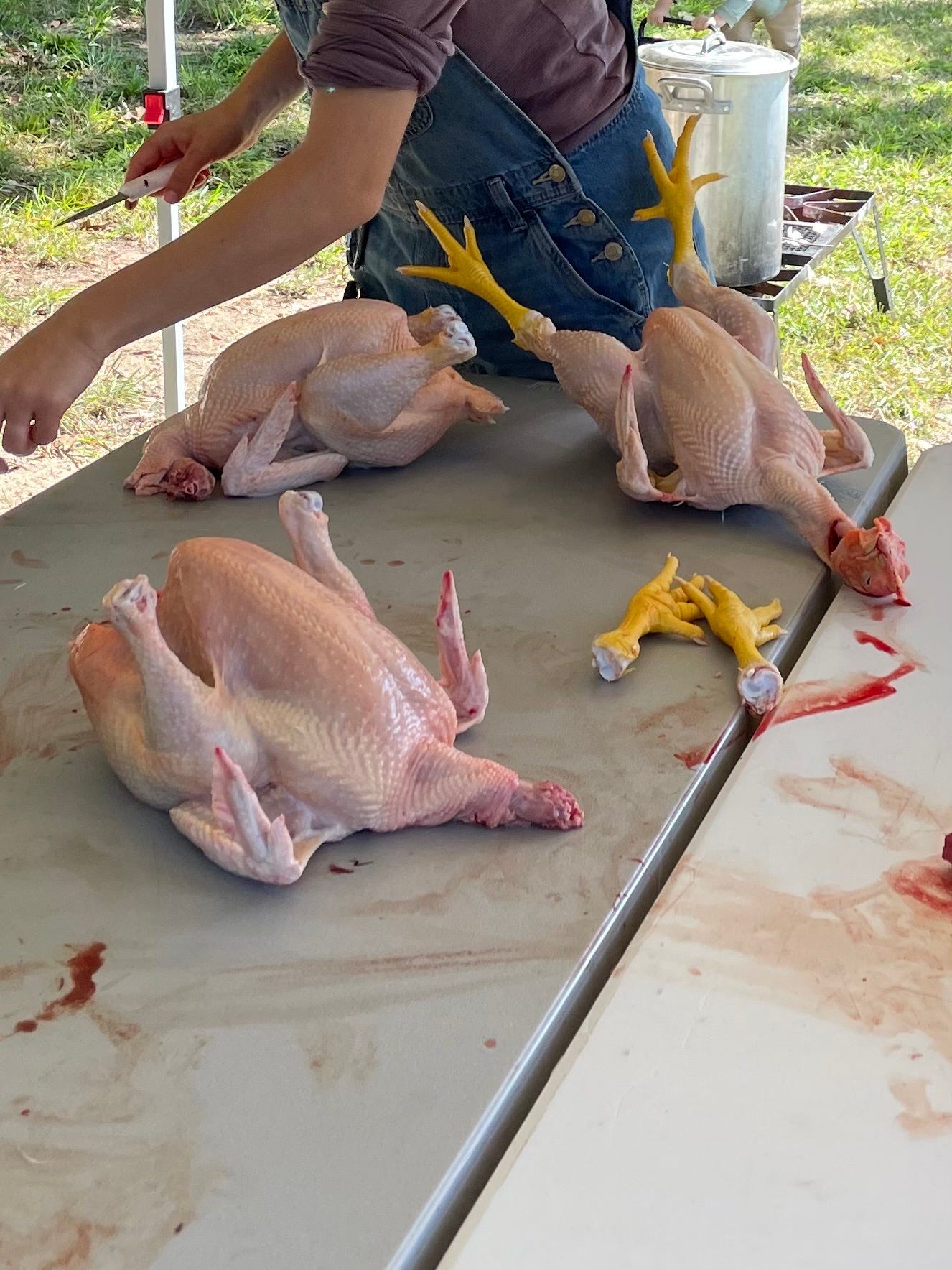
I am not squeamish but still worried about how my body would react to the process, to the feel of flesh splitting beneath the knife in my own hand, to see the fresh blood dripping down the tree into the earth. In the moment it felt fine, natural even, as the seven or so people gathered began to find a rhythm together: plucking birds from the tractor, sliding them head first into the cones, boiling them before dropping them into the washing-machine-looking drum that removed the feathers (apparently it takes a good 20 minutes to de-feather one bird by hand, they purchased one of these machines immediately after processing their first batch without one), then bringing them to the sanitized tables for the final steps (removing the innards, cutting off the feet and heads). After trying out each job, I found that I enjoyed the parts that involved the feathered bird more than the raw, naked ones, something about handling and then taking the life felt simpler than butchering what was left after we defiled its body. However, after a couple of hours and after taking the life of dozens of birds, I began to feel something rising within me, emotions that I didn’t have names for. I cleaning myself up, collected my daughter and our things, and drove home in an eerie and emotionally charged silence.
I was incredibly moved and at a loss for words after participating in something so necessary yet simultaneously gruesome.
In one of my tarot decks, the Emperor is an image of a man holding a butcher knife - the author writes about how her father raised their chickens growing up and one year when she chose to bypass assisting on processing day, she went without chicken for most meals that season. I am not sure what truth there is to that but the message sticks with you. The Emperor calls the reader to be steadfast, asking you to put emotions aside in times when tenacity is required. The butcher probably doesn’t want to slaughter the animals any more than you do, but he does what it necessary to provide for and feed his family. If you eat meat or any animal byproducts, I think understanding and even being intimate with the process of raising and slaughtering those animals is required reading.
I lightly feared that I would never eat chicken again. Instead I gained more respect for myself and for the meat that I put in my body. I have already been on that journey with produce as I began gardening and growing a lot of the vegetables, herbs, and berries that my family consumes about four years ago. Now that I have participated in the process of slaughtering and butchering chickens, I want to do the same for everything that I eat. I want to be bathed in the blood of the animals who lose their lives so that mine may continue; I will not let them die in vein. Shortly after this experience, I began purchasing only whole chickens at the grocery store or farm stands, and I butcher the whole thing myself. It is more affordable, and makes you experiment with cooking and using different parts of the bird: we usually grill the breast, tenderloins, and thighs that same day, I save up the wings and drums in the freezer and we do wing night once enough are saved up, and I make the richest, tastiest chicken broth with the leftover carcass and frozen vegetable scraps.
Things worth having take time, good things take time. They take energy. Care. Nutrients. Attention. Love. It is easier to be grateful for the delicious meal on your dinner table when you know the hands that sewed the seeds and raised the flock. Even if you never step into the farmer’s boots for yourself, you can support his efforts. You can breathe life back into your food and quit casually consuming.
omg okay i genuinely appreciated the depth of how to kill a chicken! i am mostly vego but i would feel compelled to kill my meat if i ate it